
Posted by Rob Whalley
The Changing Priority of CAFM: Integration or Intelligence?
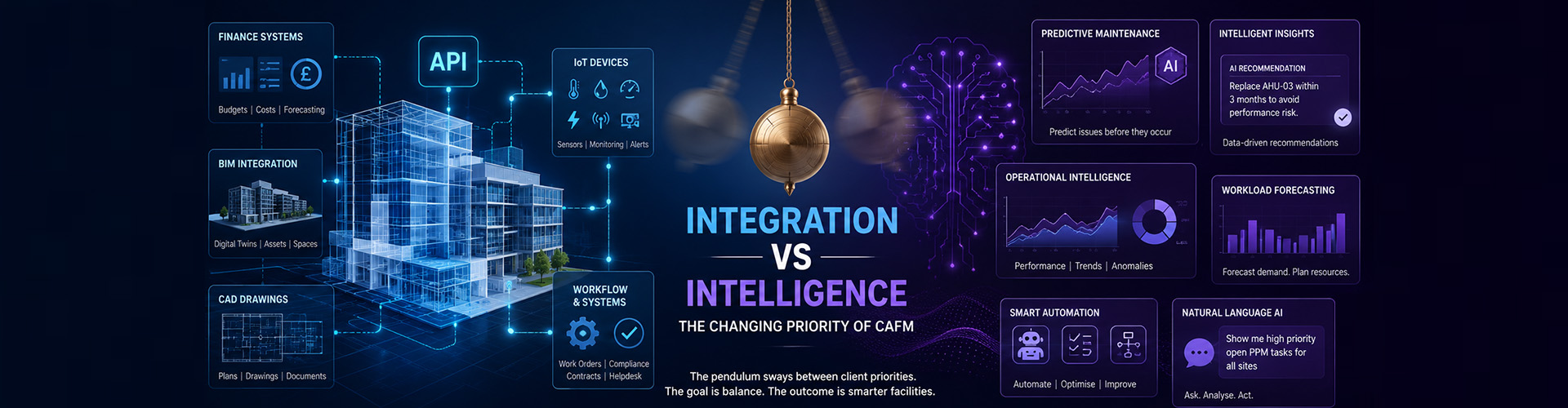
For years, the Facilities Management technology conversation has largely centred around one thing: integration.
Can the CAFM system integrate with finance platforms?
Can it pull data from BIM models?
Can it connect with CAD drawings?
Can IoT sensors feed real-time information into the system?
And for good reason. Modern estates and facilities teams operate across increasingly complex environments where data exists everywhere. Finance systems hold budgets and asset depreciation. BIM contains building intelligence. CAD drawings provide spatial context. IoT devices offer live environmental and operational data.
Historically, the “best” CAFM platform was often viewed as the one capable of serving as the central hub connecting all these systems. But the conversation is beginning to shift. The rise of AI is introducing a new question:
Should the future priority of CAFM be connectivity… or intelligence?
The Traditional Priority: Building the Connected Estate
Over the last decade, organisations have heavily invested in integration strategies. The logic was simple:
- reduce duplicate data entry
- improve visibility
- automate workflows
- centralise operational information
- create a “single source of truth”
In many environments, this remains absolutely critical.
Finance System Integration
Finance integration continues to be one of the most requested requirements within CAFM projects. Whether linking to SAP, Unit4, Oracle, Sage, or other ERP systems, organisations increasingly want:
- automated purchase order workflows
- budget tracking
- contractor cost visibility
- lifecycle costing
- capital planning data
- asset depreciation management
Without this integration, facilities teams often end up operating in silos.
BIM & CAD Integration
The same applies to BIM and CAD.
The promise of a digital twin environment remains attractive:
- clickable floorplans
- spatial asset intelligence
- room utilisation visibility
- lifecycle tracking
- improved project handover information
For some organisations — particularly healthcare, higher education, science parks, and large commercial estates — these integrations can provide enormous operational value.
IoT and Smart Buildings
IoT integration has perhaps generated the biggest excitement over recent years. Sensors can now provide:
- occupancy monitoring
- temperature and humidity data
- energy consumption
- predictive maintenance indicators
- air quality monitoring
- equipment runtime analytics
The vision is compelling:
A truly intelligent building feeding real-time operational data directly into the CAFM platform.And yet despite all of this capability, many organisations still struggle to fully harness the data they already possess.
The New Shift: From Data Collection to Data Intelligence
This is where AI enters the conversation. Because collecting data is no longer the biggest challenge. Understanding it is.
Many organisations already have:
- thousands of assets
- years of maintenance history
- contractor performance records
- compliance data
- helpdesk trends
- energy information
- inspection results
- occupancy statistics
The real issue is extracting meaningful intelligence from it quickly enough to support decision-making.That’s why the focus is beginning to shift from:
“Can the system connect to everything?”
to:
“Can the system help us understand what matters?”
AI’s Potential Within CAFM
The possibilities for AI within CAFM are significant. Not simply in the form of chatbots or automated responses, but in genuine operational intelligence.Examples could include:
- identifying maintenance trends before failures occur
- predicting reactive workload spikes
- highlighting compliance risks automatically
- analysing contractor performance anomalies
- recommending lifecycle replacement priorities
- identifying inefficient asset behaviour
- summarising large volumes of operational data instantly
- improving helpdesk triage and categorisation
- assisting with resource allocation
In theory, AI could transform CAFM systems from passive databases into active operational advisors.And that’s a major shift in thinking.
the Pendulum Continues to Sway
What’s interesting is how quickly client priorities can change. In one meeting, the priority may be:
“We need deep API integration into every corporate platform.”
In the next:
“We’re interested in AI and automation.”
Then shortly afterwards:
“Actually… we just need a reliable CAFM platform that solves our day-to-day operational challenges.”
And this is where the industry currently finds itself.
The pendulum continues to swing between:
- integration ambitions
- operational intelligence
- smart building aspirations
- practical operational needs
- digital transformation goals
- budget realities
- ease of use
- long-term value
There is no single universal priority.
Different Organisations Sit at Different Stages
One of the biggest misconceptions in CAFM technology is assuming every organisation is pursuing the same maturity journey.
They aren’t.
Some organisations are still focused on:
- digitising paper processes
- improving reactive maintenance
- gaining asset visibility
- achieving compliance consistency
Others are now pursuing:
- advanced integrations
- automation
- predictive analytics
- AI-assisted operations
- smart building strategies
Both are valid. The priorities depend entirely on:
- estate complexity
- operational maturity
- internal resources
- business objectives
- organisational culture
- existing technology landscape
So What Should the Priority Be?
The answer is probably balance.
A CAFM platform still needs strong integration capability. Open APIs, interoperability, and data connectivity remain essential foundations. But equally, simply integrating systems without deriving actionable intelligence from the data can create enormous complexity without proportional value.
Likewise, AI without meaningful operational data behind it risks becoming little more than a feature list. The future of CAFM is unlikely to belong solely to:
- integrations
- AI
- BIM
- CAD
- IoT
- or finance connectivity
Instead, it will likely belong to platforms capable of balancing all of them intelligently and pragmatically. Perhaps that’s where the real challenge now lies. Not just building connected systems. But building systems that genuinely help organisations operate more effectively.











































Follow us:
GDPR (Data Privacy)
Disclaimer
COVID-19