
Posted By Rob Whalley
The Power of Scalability in Modern CAFM Systems: Managing Multiple Clients, Sites, and Spaces with Ease
In today’s facilities and estates landscape, organisations rarely operate from a single building. Whether you’re a service provider managing dozens of customers, a multi-academy trust with multiple campuses, a healthcare trust with various hospital sites and community centres, a local government organisation, or a commercial enterprise with a national property portfolio, scalability is everything. A modern CAFM (Computer-Aided Facilities Management) system must seamlessly support multi-client, multi-site, and multi-location operations — without compromising control, visibility, or user experience.
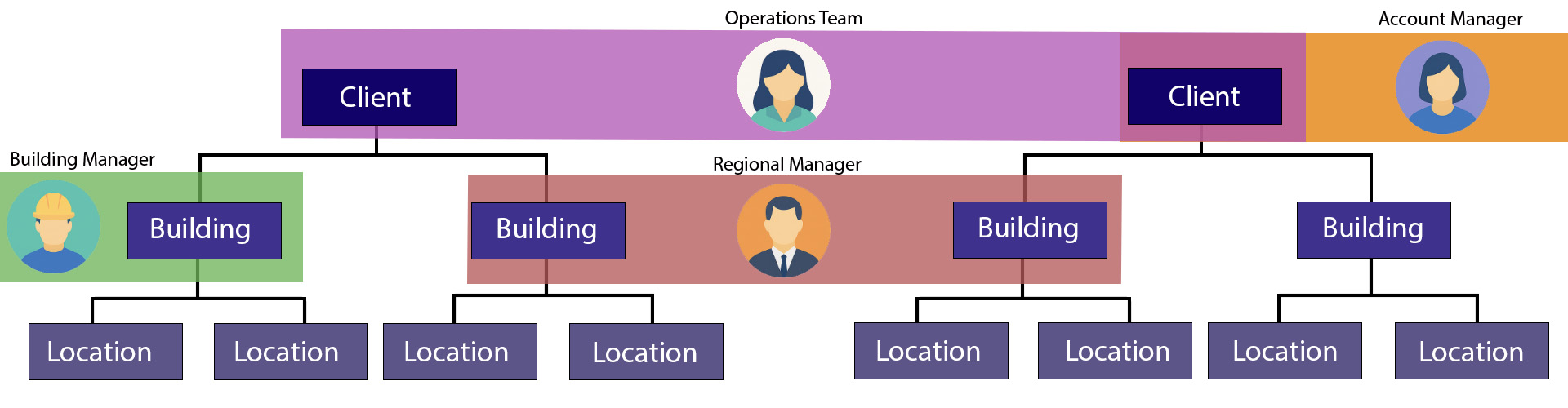
At the heart of this scalability is a well-structured data hierarchy. By clearly linking clients, sites, and spaces, a CAFM platform can deliver precise control of information and filter it in ways that directly support day-to-day operations.
A Clear Data Hierarchy: Client → Site → Space
A scalable CAFM solution organises estate information using a layered data hierarchy:
Client
The highest tier, typically representing a company, trust, division, or department. For service providers, this might reflect multiple customer accounts; for multi-site organisations, this could represent internal business units or regions.
Site
Below each client sits one or more sites — campuses, buildings, depots, offices, laboratories, retail units, or estates. Each site carries its own attributes, such as address, access details, operational hours, and local compliance requirements.
Space (Location)
Spaces represent the individual rooms, assets locations, zones, or areas within a site. These granular locations feed into asset registers, planned maintenance libraries, fire safety tracking, room booking, condition surveys, and more.
This hierarchical structure isn’t just for tidiness — it is the backbone that allows a CAFM system to scale without creating chaos.
Targeted Filtering for Local Operations
With clear hierarchy comes intelligent filtering.
A modern CAFM system can automatically filter priorities, worker lists, jobs, assets, schedules, and compliance tasks based on site and client. This ensures that:
- Client or Site-specific SLAs can be applied to jobs
- Systems can offer a list of available workers based on the geographical areas covered
- Local workers only see the jobs relevant to the site they are responsible for
- Contractors receive tasks based on the sites they are authorised to support
This streamlines workflows, reduces travel time, and improves accuracy and response performance.
Controlled User Access: Right Access for the Right Role
Scalability is as much about control as it is about growth. As the number of clients and sites increases, a CAFM system must maintain strict data governance.
Granular permission structures allow administrators to restrict users so they can only:
- See specific clients
- See specific sites within those clients
- Access only certain modules or functions
- Action work only in pre-defined locations
- View only assets, documentation, and compliance records within their remit
This ensures client confidentiality, supports internal segregation, and reduces operational risk.
At a higher level, regional managers, operational leads, and senior facilities teams can be granted broader visibility — enabling them to oversee multiple sites, compare performance, and manage resources across wider estates.
Supporting Growth Without Reconfiguration
A scalable CAFM system should grow as the organisation grows — without requiring restructuring or duplication.
Key capabilities include:
- Quickly adding new clients, buildings, or locations at no extra cost
- Copying templates such as PPM regimes, SFG20 schedules, or workflow rules
- Expanding user groups while maintaining consistent permissions
- Applying regional logic for KPIs, SLAs, and reporting
- Maintaining data separation for confidentiality and contractual requirements
With the right CAFM platform, onboarding a new site should feel like adding another branch to a well-organised tree — not rebuilding the forest.
Empowering Multi-Site and Multi-Client Success
Whether you’re managing a local cluster of buildings or a nationwide client base, scalability is no longer optional. A CAFM system must support:
- Complex estates
- Multiple stakeholders
- Distributed workforces
- Layered approval chains
- Regional performance reporting
- Varied compliance obligations
By leveraging a clear client-site-space hierarchy, enforcing role-based access, and filtering operations intelligently, organisations can maintain clarity, control, and efficiency at any scale.
A scalable CAFM system doesn’t just organise your estate — it empowers your teams to deliver consistent, compliant, and high-quality service across every site and every client touchpoint.
If you are considering adopting a CAFM system to meet your scalable needs, please contact sales@tabsfm.com to start a discussion.





































Follow us:
GDPR (Data Privacy)
Disclaimer
COVID-19